
Cybersecurity has changed a lot in recent years. A business can have good antivirus software installed and still have gaps that attackers can take advantage of. Employees work from laptops, offices use shared systems, companies rely on servers and cloud applications, and remote users connect from different locations. Every connected device adds another point that needs attention.
That is one of the reasons Endpoint Detection and Response, commonly called EDR, has become an important part of business security.
EDR does more than look for known viruses. It watches activity on endpoint devices, picks up unusual behavior, helps security teams investigate what happened, and gives them tools to respond when something looks wrong. For a business dealing with customer information, financial data or important applications, that visibility can be extremely useful.
What Is EDR in Cyber Security?
Endpoint Detection and Response is a security technology that monitors devices such as laptops, desktops, servers and virtual machines. Instead of checking a device only when a security alert appears, EDR keeps an eye on activity over time.
It can collect information about running processes, files, network connections, user activity and changes made to the system. That information helps the security platform identify behavior that may point to a security incident.
For example, imagine an employee opens an attachment from a convincing-looking email. A process starts running, changes several files and then attempts to connect to an unfamiliar server. A traditional antivirus product may block the known malicious file, but EDR can also look at the sequence of events and flag the behavior.
If a real threat is confirmed, the security team can investigate it and take action. Depending on the setup, an affected computer can be isolated, a malicious process can be stopped and other response measures can be taken.
So, the purpose of EDR is not simply to prevent malware. It is about seeing what is happening, finding threats earlier and making the response faster.
Why EDR Is Essential for Modern Businesses
Attackers do not always use obvious malware anymore. Ransomware, phishing, stolen credentials, fileless attacks and newly discovered vulnerabilities can all be used to gain access to a business environment.
That makes visibility important.
EDR can help a business:
- Spot suspicious behavior that may not look like traditional malware
- Keep track of activity across endpoint devices
- Investigate security alerts in more detail
- Respond to incidents faster
- Isolate a device when it has been compromised
- Understand how an attack started and what it affected
- Strengthen the company’s overall endpoint security
Remote work has made this even more relevant. A company may have employees using business devices from home, while other staff work from an office or travel between locations. Protecting every endpoint consistently becomes harder when the environment is spread out.
EDR gives security teams a central view of endpoint activity instead of leaving them to investigate every device separately.
How EDR Works: Detection, Analysis, and Response
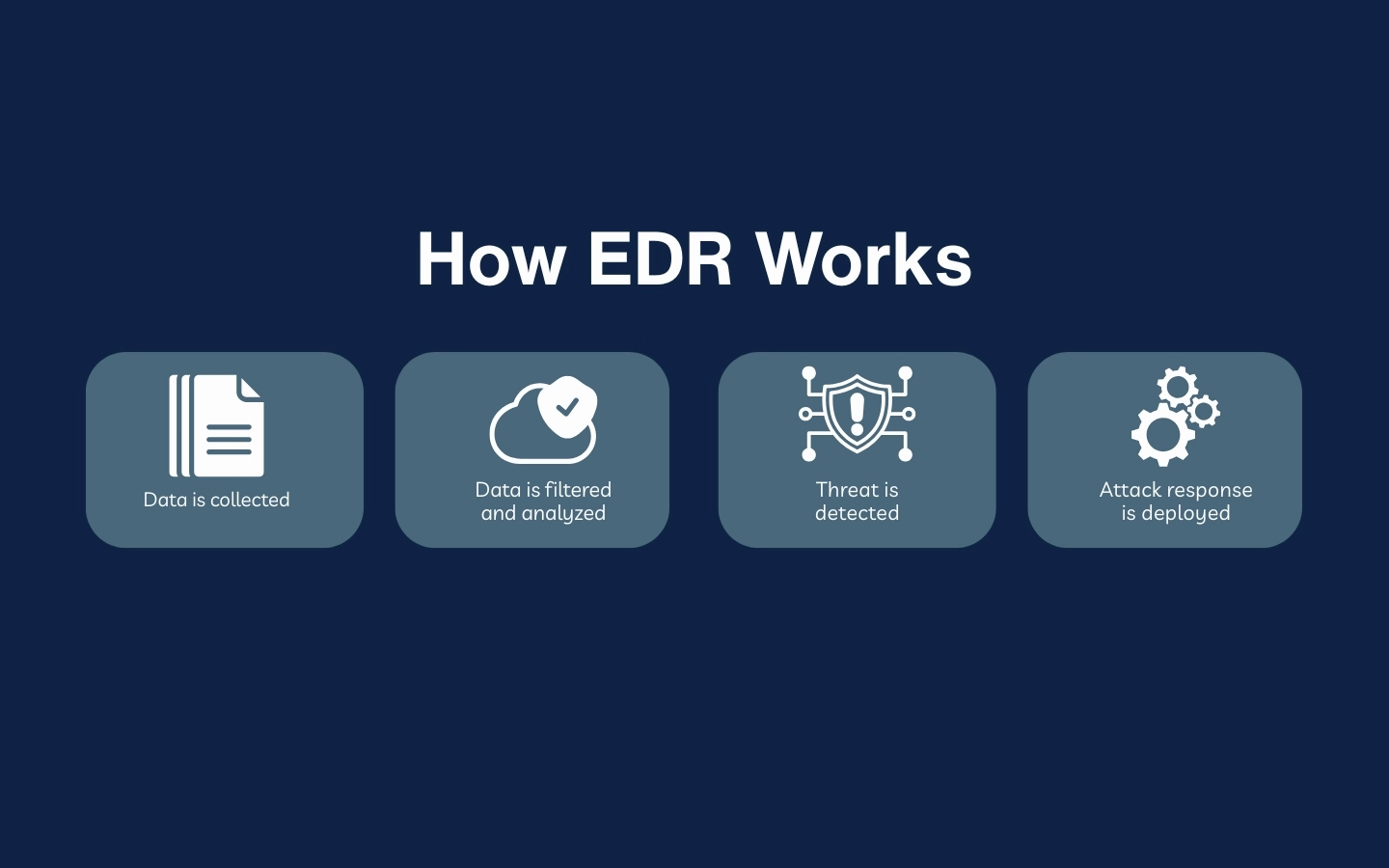
Detection
An EDR agent runs on a protected endpoint and observes activity on that device. This can include processes, file changes, applications, network connections and other system events.
The platform then looks for behavior that could indicate a threat. Behavioral analysis, threat intelligence and machine learning can all be used to help ide
Analysis
A security alert is not always proof that an attack has happened. Security teams need to understand the context before deciding what to do.
EDR can help by bringing related events together. Investigators may be able to see which process started first, what files were touched, which user account was involved and what network connections were made.
That information makes it easier to work out whether the alert is harmless activity or part of an actual attack.
Response
Once a threat has been identified, time matters. The longer an attacker stays inside an environment, the more opportunity there is for damage.
EDR can support actions such as isolating an endpoint, stopping a malicious process, blocking a suspicious file and beginning remediation. Some actions can be automated, while others can be handled by an IT or security team.
The aim is straightforward: contain the problem before it moves to other systems.
EDR vs Traditional Antivirus
Antivirus is still useful, and businesses should not think of it as obsolete. The difference is mainly in the level of visibility and response.
Traditional antivirus generally focuses on detecting and blocking known malicious files or patterns. EDR looks at endpoint behavior as well as known threats.
Here is the simple difference:
- Detection: Antivirus commonly relies on signatures and established security rules. EDR also looks for unusual behavior.
- Visibility: Antivirus usually gives less detail about what happened. EDR can show processes, files, connections and other endpoint events.
- Response: Antivirus can block or quarantine threats. EDR can also help investigate, isolate and remediate affected devices.
- Threat coverage: Antivirus is strong against many known threats, while EDR is designed to help with more advanced and unfamiliar activity.
In practice, EDR and antivirus can work together. One does not automatically make the other unnecessary.
Core Features of an Effective EDR Solution
When a business is comparing EDR solutions, it should look beyond the word “EDR” on a product page. The actual features and how they fit the business environment matter.
- Continuous Endpoint Monitoring: Provides real-time visibility into endpoint activities, processes, and user behavior to quickly identify suspicious actions.
- Behavioral Threat Detection: Detects abnormal patterns and malicious behavior instead of relying solely on known malware signatures.
- Automated Response and Remediation: Rapidly isolates infected endpoints, stops malicious processes, and minimizes potential damage.
- Threat Hunting Capabilities: Allows security teams to proactively search for hidden or dormant threats across endpoints.
- Forensic Investigation Tools: Delivers detailed attack timelines, event logs, and root cause analysis for faster incident resolution.
- Centralized Management Console: Simplifies monitoring, reporting, and response across all endpoints from a single dashboard.
Common Cyber Threats EDR Helps Prevent
EDR is designed to protect against a wide range of modern and sophisticated cyber threats, including:
- Ransomware attacks: hat encrypt critical business data and disrupt business operations.
- Zero-day exploits: hat take advantage of unknown vulnerabilities to bypass traditional security defenses.
- Fileless malware: that operates directly in memory, leaving little or no footprint on disk.
- Phishing-based endpoint compromise: where attackers gain access through malicious emails or links.
- Insider threats and privilege misuse: caused by compromised or malicious users within the organization.
- Advanced Persistent Threats (APTs): that remain undetected for long periods to steal data or spy on systems.
By identifying abnormal behavior early, EDR helps organizations stop threats before they escalate into major security incidents.
Benefits of EDR for Small, Medium, and Large Enterprises
EDR delivers value to organizations of all sizes by providing real-time threat detection, rapid response, and improved endpoint visibility across environments.
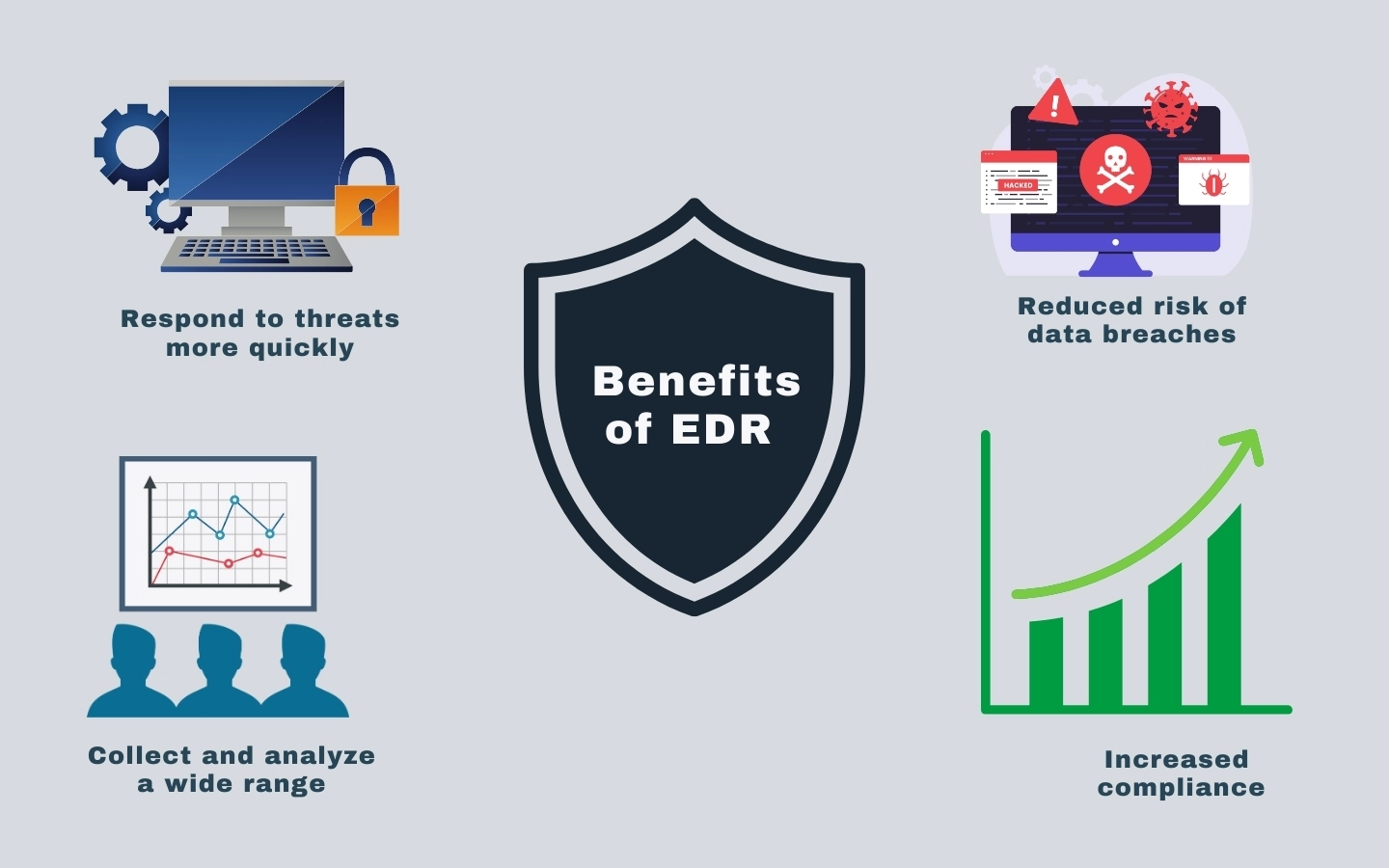
For Small Businesses
- Enterprise-grade security without complex infrastructure
- Reduced risk of costly ransomware attacks
- Improved visibility with limited IT resources
For Medium-Sized Businesses
- Scalable protection across growing endpoints
- Faster incident response and reduced downtime
- Support for compliance and audit requirements
For Large Enterprises
- Advanced threat detection across complex environments
- Centralized control for thousands of endpoints
- Integration with broader security ecosystems
Regardless of size, EDR strengthens cyber resilience and business continuity.
Challenges and Limitations of EDR Solutions
EDR is powerful, but installing it does not automatically solve every security problem.
One issue businesses can face is alert fatigue. If the system generates too many alerts and nobody reviews them properly, important warnings can get lost among less important notifications.
There is also a skills requirement. Someone needs to understand the alerts, investigate incidents and know what action to take.
Integration can be another consideration. Most businesses already use firewalls, email security, backup systems and other IT tools. The EDR platform needs to fit into that environment rather than create another isolated system.
For these reasons, implementation and ongoing management are just as important as the software itself.
EDR vs XDR vs MDR: Understanding the Differences
The terms EDR, XDR and MDR can sound confusing because they are closely related, but they are not the same.
EDR concentrates on endpoint devices. Its job is to monitor, detect, investigate and respond to threats at the endpoint level.
XDR takes a wider view. It can bring security information together from areas such as endpoints, email, networks, servers and cloud environments.
MDR, or Managed Detection and Response, is a managed security service. Instead of relying completely on an internal team, a business can have security professionals monitor and respond to threats for it.
A business may start with EDR and later expand its security setup as its needs become more complex.
Why Acronis EDR Is a Smart Choice for Businesses
Acronis approaches cyber protection from more than one angle. Its solutions bring security, backup and recovery capabilities together, which can be useful for businesses that want to reduce the number of separate systems they have to manage.
Acronis EDR can be considered alongside services such as Acronis Cyber Protect, Acronis Cloud Backup, Acronis Detection and Response, Acronis Advanced Email Security, and backup and recovery.
This wider approach matters because finding an attack is only part of the problem. If important files are damaged or systems become unavailable, the business also needs a way to recover.
Key Advantages of Acronis EDR
- Behavioral threat detection
- Automated response and remediation
- Endpoint security
- Centralized management
- Backup and recovery capabilities
- Support for ransomware resilience
- Integration with broader cyber protection services
The combination of security and recovery gives businesses a more practical way to think about cyber risk. It is not only about stopping an attacker; it is also about being prepared for what happens if an incident gets through.
Acronis Cyber Protection Services in Dubai
Endpoint Detection and Response may be an important part of a company’s security plan, but it is not necessarily the only part it needs.
Acronis Dubai provides access to Acronis-focused cyber protection solutions that can be selected according to the business environment.
These include:
- Acronis EDR for endpoint detection and response
- Acronis Cyber Protect for broader cyber protection
- Acronis Cloud Backup for business data protection
- Acronis Backup and Recovery for restoring data and systems
- Acronis Detection and Response for threat monitoring and response
- Acronis Advanced Email Security for email-based threats
- Disaster Recovery for business continuity and recovery planning
The right combination depends on the company’s endpoints, users, applications, data and recovery requirements. A small office and a large organization will not necessarily need the same setup.
How Acronis Dubai Help With EDR
Choosing an Endpoint Detection and Response product is one step. Getting it configured properly is another.
Acronis Dubai can help businesses review their environment and decide how Acronis solutions can fit into their existing IT and security setup.
Support can include:
- EDR assessment and consultation
- Acronis EDR deployment and configuration
- Endpoint security setup
- Security policy configuration
- Acronis Cyber Protect implementation
- Cloud backup planning
- Backup and recovery configuration
- Ongoing technical support
The objective is to build something practical for the business rather than adding security tools simply because they are available.
Best Practices For Implementing EDR
A few basic practices can make an EDR deployment much more effective.
Know Your Endpoints
Maintain an up-to-date list of laptops, desktops, servers and other devices that need protection. You cannot properly secure devices you do not know about.
Cover the Whole Environment
Protecting only a few critical servers is not enough if an attacker can enter through an employee’s laptop. Endpoint coverage should be planned across the business.
Review Security Policies
Security rules should be adjusted as the environment changes. This can also help reduce unnecessary alerts.
Train the IT Team
People managing EDR should know how to read alerts, investigate incidents and respond appropriately. Good technology still needs people who know how to use it.
Keep Reviewing Alerts
An EDR platform should not be installed and then forgotten. Regular reviews help businesses understand recurring problems and improve their security posture over time.
What Is the Future of EDR
Endpoint security is continuing to develop as attackers find new ways to compromise businesses.
Artificial intelligence and machine learning are becoming more important in security monitoring. EDR platforms are also moving closer to XDR-style protection, where information from different security layers can be analyzed together.
Cloud-based security is another major change. Businesses now need protection for office devices, remote workers, cloud workloads and systems that may not sit inside a traditional corporate network.
The direction is fairly clear: endpoint security is moving beyond basic malware blocking. Businesses increasingly need continuous visibility, smarter detection, quicker response and reliable recovery.
Conclusion
Endpoint Detection and Response has become an important part of a modern cybersecurity strategy because businesses need to know more than whether a virus has been detected. They need visibility into what their devices are doing and a practical way to respond when something unusual happens.
It helps with that by monitoring endpoints, detecting suspicious behavior, supporting investigations and providing response capabilities.
For businesses in Dubai, Acronis offers a broader cyber protection approach that can bring endpoint security together with backup, recovery, email protection and other services.
Acronis EDR can therefore be part of a wider strategy built around protecting devices and data while keeping the business prepared for unexpected incidents.
Protect Your Business With Acronis Dubai
A cyber incident can happen quickly, but recovering from it can take much longer if the business is not prepared.
If you are reviewing your endpoint security, looking for better backup protection or planning a more complete cyber protection strategy, Acronis Dubai can help you understand the available options.
From Acronis EDR and Acronis Cyber Protect to Acronis Cloud Backup, Detection and Response, Advanced Email Security, backup and recovery, and disaster recovery, the right combination can help your business improve both security and resilience.
Talk to Acronis Dubai today about your cybersecurity, endpoint protection, backup and recovery requirements.